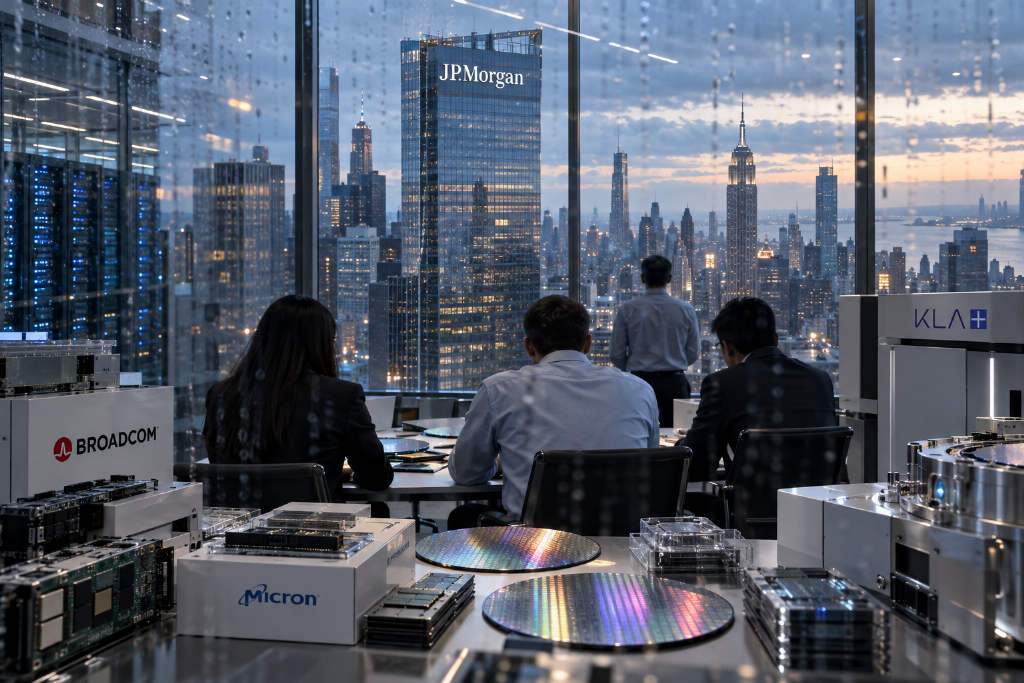
JPMorgan2026-09-20 06:31:03JPMorgan Sees Stronger Semiconductor Fundamentals, Puts 2026 Cloud Capex at $954 BillionJPMorgan said in its Sept. 18 U.S. semiconductor and semiconductor equipment autumn report that industry fundamentals are improving and the recent pullback in chip stocks looks constructive rather than disruptive. The bank’s model projects semiconductor industry growth of 118% in 2026 and 35% in 2027, while wafer fab equipment is seen rising 31% in 2026 and 38% in 2027. A key pillar in that view is cloud capital spending, which JPMorgan now estimates at $954 billion in 2026, climbing to $1.41 trillion in 2027 and $1.54 trillion in 2028. The bank said early AI monetization and return-on-investment signals are becoming easier to see, with faster cloud and AI revenue growth, larger backlogs, more long-term contracted capacity, and improving profitability across cloud and AI businesses. JPMorgan also highlighted custom AI ASICs and memory as two major themes in the current upcycle. It estimates the custom AI ASIC market at roughly $60 billion to $70 billion in 2026, with a 40% to 50% compound annual growth rate over the next several years, and forecasts DRAM and NAND pricing to rise about 250% in 2026. Among its preferred names, the bank listed Broadcom, Analog Devices, Marvell, Micron and KLA in large caps, while also favoring Nvidia, Applied Materials and Lam Research.790
Nvidia2026-08-24 08:21:54Goldman Sachs expects strong Nvidia earnings but says much of the upside may already be priced inNvidia is scheduled to report results for the second quarter of fiscal 2027 after the U.S. market closes on Aug. 26, according to ChainCatcher, citing Cailian Press. Goldman Sachs expects a strong earnings print and sees room for the company to raise guidance, but it also argues that the recent share rally may limit the stock reaction even if the numbers come in well. The bank said Nvidia shares have already climbed sharply since the start of August, including a gain of more than 12% over the past two weeks, suggesting that positive expectations may have been reflected in the price ahead of the report. Goldman forecasts Nvidia’s EPS for the second and third quarters at 6% and 12% above Wall Street consensus, respectively. Even so, its $285 price target remains slightly below the broader market average. Investors are expected to focus on details from the earnings call, including the company’s customer financing platform, progress on the Vera Rubin platform, gross margin and raw material costs, CPU demand tied to agentic AI, and the competitive picture across the industry. Goldman also said Nvidia still faces risks tied to a possible pullback in GPU demand, growing difficulty in delivering quarterly beats alongside higher guidance, and uncertainty over whether cloud providers will continue increasing capital spending.1170
GF Securities2026-08-13 05:29:11GF Securities says AI stock correction is nearing an end as capital rotates from memory to CPO opticsHong Kong-based GF Securities said in its August technology sector report that the July pullback in AI-linked stocks is close to ending, with the Philadelphia Semiconductor Index seeing its forward P/E fall to 27x and crowded leveraged positions largely cleared out. The firm added AMD, Foxconn and Lumentum to its preferred list while removing United Microelectronics, MediaTek and ASML, arguing that current leadership is concentrated in GPU, CPU and optics rather than mature-node foundry, smartphone chips or front-end lithography. GF Securities also said supply-chain capital is rotating away from memory components toward optical interconnects, with near-packaged optics and co-packaged optics emerging as the next focus. It projected U.S. cloud service providers’ capital expenditure growth at 85% in 2026, 45% in 2027 and about 20% in 2028, while estimating debt issuance at $257 billion in 2026 and $419 billion in 2027. The report said net leverage should still stay around 0.5x by 2029. At the same time, it kept a cautious near-term view on smartphones and warned that NAND oversupply could begin to surface in the second half of 2027.1900
AI servers2026-08-07 04:16:44TrendForce Sees ~90% Jump in 2026 Cloud Capex, Lifts AI Server Growth ForecastTrendForce expects capital spending by the world's nine largest cloud providers to climb roughly 90% year over year in 2026. The research firm points to stronger demand from hyperscale CSPs and tier-2 data centers for NVIDIA's rack-scale AI servers. It also notes that Google and AWS will ramp next-generation ASIC platforms in the second half of 2026. As a result, the annual growth forecast for AI server shipments has been revised up from 28% to nearly 31%.2190
Morgan Stanle2026-08-01 10:07:00Morgan Stanley says the semiconductor upcycle is far from over, with cloud capex nearing $1.3 trillion by 2027Morgan Stanley said in its latest Greater China semiconductor report, released on July 31, that AI semiconductors are still in a strong upcycle and that demand is no longer limited to GPUs alone. The bank said the current wave is spreading across advanced process nodes, advanced packaging, memory, testing equipment, ASICs, and China’s AI chip supply chain. The report also laid out an aggressive market forecast. Morgan Stanley said the cloud AI semiconductor market could reach $485 billion in 2026 and expand to about $753 billion by 2030. Over the same period, it projected the global semiconductor market could grow to $1.5 trillion by 2030, implying that AI semiconductors would account for nearly half of the total market. Using its own cloud capex tracking model, Morgan Stanley estimated that cloud capital spending by the world’s top 14 listed cloud service providers could approach $1.3 trillion in 2027. The bank added that this figure does not include sovereign AI projects.2070
Morgan Stanle2026-07-07 08:45:37Morgan Stanley Says Memory Stocks May Face Near-Term Pressure, but 2027 Earnings Growth Still Seen at 35%-40%Morgan Stanley said in its July 6 Asia-Pacific memory technology note that the storage sector is approaching peak rates of change in year-over-year pricing, inventories, and earnings revision breadth, suggesting that memory names could face near-term share price pressure. Even so, the bank argued that the AI-driven memory upcycle is far from over and still expects industry earnings to grow by 35% to 40% in 2027. It also said concerns about compute overcapacity at leading cloud providers may be overstated, with the real signal likely to come from whether hyperscalers maintain capital expenditure through the second-quarter earnings season. On positioning, Morgan Stanley prefers DRAM and traditional memory exposure while staying cautious on module makers. The bank also estimated second-quarter operating profit at about KRW 85 trillion for Samsung Electronics and KRW 65 trillion for SK Hynix, both broadly in line with market expectations.1810